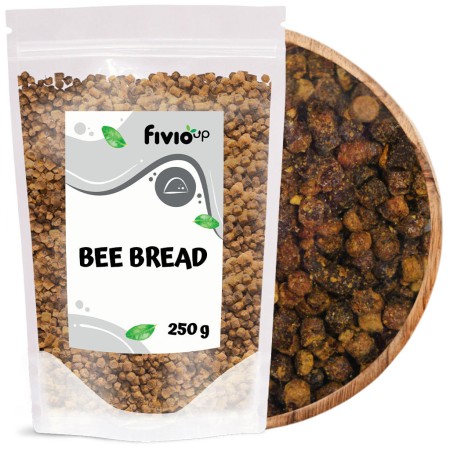

Bee bread
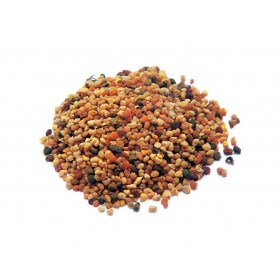
Bee bread is a unique product made by bees, known for its specific sour taste and versatile application in nutrition.
Let op: het etiket van dit product is in het Engels en Pools.
For generations, products from diligent bees have been considered a valuable part of the human diet. And although we are familiar with the properties of some types of honey, and even pollen, few are aware of the amazing characteristics that bees can offer us.
The use of bee bread
Bee bread is not as sweet as honey. It has a specific, sour taste due to pollen fermentation. The daily amount to consume is 2-3 teaspoons. For optimal use, it is recommended to take it twice a day.
Bee bread can be eaten directly from the packaging, but it should be used carefully.
You can also dissolve the bread in boiled water, milk, or honey: 1 teaspoon per glass of water. The combination with honey enhances their flavors. It is useful to prepare the bee bread dissolved in water in the morning for the evening and vice versa. The minimum soaking time for bee bread is 4 hours.
Possible considerations when consuming bee bread
In most cases, the proper use of bee bread is safe. However, there are some considerations associated with its use. People who pay attention to their calorie intake should consider the amount of bee bread they use. Additionally, some people may be sensitive to products of bee origin, so it is important to start gradually and monitor personal reactions closely.
Bee bread is made from pollen collected by bees. Pollen from the stamens of flowers is combed from the hairs of their thorax by bees, mixed with saliva and brought to the hive as pollen pellets on their hind legs. It is then stamped into cells by house bees using their head tops, with small amounts of honey, saliva, gastric juice, and beeswax added. The pollen in the cell undergoes various chemical processes due to enzyme action and matures into what is known as bee bread within two weeks.
Composition of bee bread
The composition of bee bread differs somewhat from that of pollen. It has a higher acidity (lower pH) due to the presence of lactic acid and vitamin C (ascorbic acid). This acidity makes it self-preserving and prevents it from becoming stale. Bee bread contains fewer carbohydrates and more easily assimilable proteins than original pollen and also has a higher content of fat-soluble vitamins such as E and K.

- Ingredients
- bee bread
- Type
- Supplements
- Application
- Resistance
- Warning
- Dit product wordt verpakt en/of bewaard in een omgeving waar ook producten met noten, pinda, mosterd, selderij, gluten, sesam, soja en sulfiet worden verwerkt. Ondanks alle voorzorgen is het mogelijk dat dit product sporen van deze allergenen bevat.
- Country of origin
- Latvia


Order before 15:00, expect it to be delivered tomorrow*
Shipping costs overview table
| Order amount | from €50,- | between €40 and €49,99 | between €30 and €39,99 | between €10 and €29,99 | under €10,- |
|---|---|---|---|---|---|
| Shipping costs NL | €0,- | €0,- | €2,99 | €4,95 | €6,19 |
| Shipping costs BE | €0,- | €1,49 | €3,99 | €6,49 | €7,99 |
Free pick up in Geesbrug (Drenthe):
In the third step at the checkout, choose pickup, this choice will automatically remove the shipping costs from your shopping cart. You can pick up your order for free from us in Geesbrug. This is possible on any working day (Monday to Friday) from 9:00 AM to 4:00 PM. The pick-up address is Energiestraat 6 in Geesbrug.